Thứ Năm, 31 tháng 3, 2016

Story of cities #12: Haussmann rips up Paris – and divides France to this day

Georges-Eugène Haussmann is feted internationally for transforming the French capital with an audacious programme of urban planning. Yet 125 years after his death, his legacy at home remains much more controversial. Why?
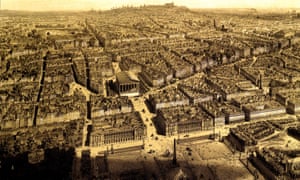
Paris in 1870

He was the Parisian who ripped up his home city; one of the most famous and controversial urban planners in history. Even now, 125 years after the death of Baron Georges-Eugène Haussmann, France remains divided over whether the man who transformed Paris into the City of Light was truly a master planner – or an imperialist megalomaniac.
Internationally, Haussmann is celebrated for much that is loved about the French capital; notably those wide avenues flanked with imposing buildings of neatly dressed ashlar and intricate wrought iron balconies.
To his republican compatriots, however, Haussmann was an arrogant, autocratic vandal who ripped the historic heart out of Paris, driving his boulevards through the city’s slums to help the French army crush popular uprisings.
Historian and Haussmann expert Patrice de Moncan is exasperated by the century’s worth of criticism that has been levelled at this hugely influential figure. “Sometimes I don’t know where to start; it’s bullshit from beginning to end,” De Moncan says. “But it’s a view many people still hold in France.
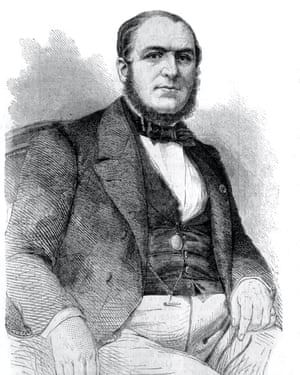
Baron Haussmann.
 Baron Haussmann. Illustration: Alamy
“Haussmann has been portrayed as this almost sinister figure, only out to enrich himself and with his fingers in the till. His critics accused him of filling Paris with cobbled streets, bland buildings with stone facades, and wide, dead straight avenues so the army could repress the masses.”
De Moncan, who is writing a new biography of Haussmann, smarts with the injustice of what he sees as the ongoing maligning of his hero. “Some said he was austere, but from what I have discovered he liked a good party and threw great ones. Others accused him of chasing the girls – it’s true he had a mistress [the opera star Francine Cellier] with whom he had a child, but unlike others at that time, he accepted, recognised and educated the girl.”
In 1848, Haussmann was an ambitious civil servant determinedly climbing the ranks when Louis-Napoléon Bonaparte – nephew and heir of Napoléon I – returned to Paris after 12 years’ exile in London to become president of the French Second Republic.
Bonaparte, later elected Emperor Napoléon III, hated what he saw. In his absence, the population of Paris had exploded from 759,000 in 1831 to more than a million in 1846 – despite regular outbreaks of cholera and typhoid that killed tens of thousands.
The French capital was overcrowded, dingy, dirty and riddled with disease. Why, Bonaparte pondered, was it not more like London, with its grand parks and gardens, its tree-lined avenues and modern sewage system? Paris, he declared, needed light, air, clean water and good sanitation.
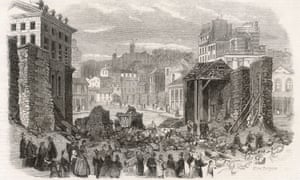
A drawing of the rebuilding of Paris under Haussmann’s command, from around 1860.
Haussmann was an imposing figure both physically – at 6ft 3in – and intellectually. Born into a bourgeois military family with strong Lutheran ties, he had been a brilliant student at elite Paris colleges, and personified the Protestant work ethic. Portraits show a tall, solid, often studious figure with a not unkind face, often sporting a chin-strap beard and, in later years, thinning hair.
France’s interior minister, Victor de Persigny, believed Haussmann to be the ideal candidate for the job of Prefect of the Seine and overseer of Napoléon III’s plan to transform the city. “He is one of the most extraordinary men of our time; big, strong, vigorous, energetic and at the same time clever and devious,” wrote De Persigny to the emperor. “He told me all of his accomplishments during his administrative career, leaving out nothing: he could have talked for six hours without a break, since it was his favourite subject, himself.”
Haussmann got the job. A week after his appointment in the summer of 1853, he was summoned to the emperor’s official residence at the Palais des Tuileries, where Napoléon III produced his plan for Paris. It showed a map of the city with three straight, dark lines drawn over it: one running north-to-south and two east-to-west either side of the Seine, all cutting through some of the most densely populated but historic areas of central Paris.
“This is what I want,” Napoléon III told Haussmann. It was the start of the most extensive public works programme ever voluntarily carried out in a European city, turning Paris into a vast building site for more than 17 years.
Haussmann cut a swathe through the cramped and chaotic labyrinth of slum streets in the city centre, knocked down 12,000 buildings, cleared space for the Palais Garnier, home of the Opéra National de Paris, and Les Halles marketplace, and linked the new train terminals with his long, wide and straight avenues.
Less well known is Haussmann’s commissioning of an outstanding collection of street furniture – lampposts, newspaper kiosks, railings – and the decorative bandstands in the 27 parks and squares he created.
Below ground, Haussmann oversaw the installation of les egouts, the city’s complex sewage network. He also commissioned reservoirs and aquaducts to bring clean drinking water to the city.
On his orders, gas lamps were installed along the widened cobbled streets; now when the elegant flâneurs who strolled the 137km of new boulevards retired for the night, the revellers and prostitutes who emerged from the bars and the shadows could walk safely. The new streets came with trees and broad pavements along which café terraces sprang up, soon to be filled with artists and artisans enjoying “absinthe hour”.
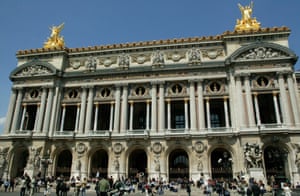
The Palais Garnier was built on the orders of Napoléon III as part of Haussmann’s grand reconstruction project.
In his Dictionary of the Second Empire, Josephy Valynseele wrote of Haussmann: “During his career he showed a maniacal ambition, an impudent opportunism and was, whatever he did, a genius of showmanship.”
But republican opponents criticised the brutality of the work. They saw his avenues as imperialist tools to neuter fermenting civil unrest in working-class areas, allowing troops to be rapidly deployed to quell revolt. Haussmann was also accused of social engineering by destroying the economically mixed areas where rich and poor rubbed shoulders, instead creating distinct wealthy and “popular” arrondissements.
Critics also accused him of destroying the city’s medieval treasures, citing the enduring charm of the narrow winding streets of the Marais: the city’s oldest district and one which escaped Haussmann’s razing.
There was additional outrage at the staggering 2.5bn franc bill for the work – around €75bn today. By 1869 the attacks had become deafening, and Haussmann was forced to vigorously defend himself before MPs and city officials. In the hope of salvaging his own flagging popularity, Napoléon III asked Hassmann to resign. He refused.
“Haussmann had a great belief in public service and had spent his whole career in the service of the king and then the emperor,” De Moncan says. “He believed if he resigned it would be assumed he had done wrong, when in fact he was very proud of what he had done. Napoléon III offered him all manner of inducements but he still refused, so the emperor sacked him.
“The Second Empire and Napoléon III were despised by republicans, and Haussmann was the victim of this political backlash. Victor Hugo hated him, and because everyone in France regarded what Hugo wrote as the word of God, they hated Haussmann too. Hugo, the man who wrote Les Miserables about how desperate conditions were in Paris, accused Haussmann of destroying the city’s medieval charm!”
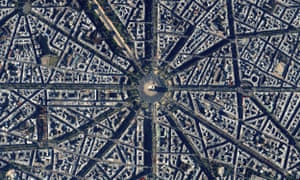
An overview of Paris, centring on the Étoile area that Haussmann redesigned.
De Moncan observes this was the same “charm” that had brought epidemics to Paris; the charm that “had 20 people living in one room with no light and no toilets, just a common courtyard into which they did their business. People like Hugo forgot how truly miserable Paris had been for ordinary Parisians.”
Out of a job and persona non grata in Paris, Haussmann spent six months in Italy to lift his spirits. He returned and was given a management post with the military – which lasted less than a week before Napoléon III was defeated.
Haussmann lived out his final days in rented accommodation on a paltry 6,000-franc pension, the equivalent of €20,000 a year today, paying regular visits to his three beloved daughters. In his memoirs, he seems stoic rather than bitter about his fall from grace:
“In the eyes of the Parisians, who like routine in things but are changeable when it comes to people, I committed two great wrongs. Over the course of 17 years I disturbed their daily routines by turning Paris upside down; and they had to look at the same face of the prefect in the Hôtel de Ville. These were two unforgivable complaints.”
Some of Haussmann’s harshest critics, including the politician and philosopher Jules Simon, later changed their view of him: “He tried to make Paris a magnificent city and he succeeded completely,” Simon wrote in 1882. “He introduced into his beautiful capital trees and flowers, and populated it with statues.”
Today, Haussmann is remembered by the grand boulevard that bears his name, on which the Palais Garnier sits, and a statue on its corner with Rue de Laborde in the 8th Arrondissement. But according to De Moncan, Haussmann’s vital contribution to modern Paris is still not fully appreciated.
“Haussmann was never forgiven or recognised in his lifetime in France, and still isn’t. If I give a conference here, people groan when I talk about him. Right up until the 1980s, his buildings were dismissed as rubbish and as many as possible were destroyed, so that all those unlovely 1970s glass and concrete structures could go up.
“But what he did was phenomenal; he was the world’s first modern urban developer. Everyone who came to Paris for the universal exhibitions, including Queen Victoria, was astonished by the transformation of the city. In 1867, there was a meeting of European architects in Germany at which Haussmann was hailed as a pure genius; a brilliant modern urban developer. Yet all that was said about him back home was that he was a crook.”
Does your city have a little-known story that made a major impact on its development? Please share it in the comments below or on Twitter using #storyofcities

Thứ Năm, 21 tháng 1, 2016

A lifelong love of books


This is the latest in a series of articles on the life and times of Kim Jong-pil, a two-time prime minister, based on extensive interviews with the 90-year-old.

When I was a child, I was known for running wild around my village, but also for my affinity for reading. By the time I was in fourth grade, I was already fascinated by the memoirs and biographies of world leaders, especially the ones on French hero Napoleon Bonaparte. 

I was most fond of biographies of people with excellent leadership skills, like Napoleon, and I found myself delighted by the idea of the limitless achievements of humanity. 

History is made by men, I thought, so therefore I must understand the men who have made history. 

I spent numerous nights reading books. There are more than 30 books written by and about former British Prime Minister Winston Churchill, and I have read all of them, cover to cover. 

But it was during my middle school years when I read the most. I finished reading a collection of classic novels written in Japanese. Back then, I had a rule that I had to read one book each night, and when I couldn’t finish, I would skip class to do so. 

When my Japanese teacher noticed my absence, he would send one of his students to my dormitory to call on me. “Jong-pil is being stubborn again about finishing one book each night,” he would say.

Admittedly, I was proud of my reading habits at the time. I felt proud citing famous poems in Japanese as I walked by classrooms. Most of the books I read at the time were in Japanese, as the Korean Peninsula was under colonial rule, and it was extremely difficult to find books in Korean. Some books were translated into Korean, but they had errors and distortions from the original English version because they were translated from English to Japanese, then to Korean again. 

At 90, I still read books. I wake up at around 3 a.m. and indulge myself over and over again. But these days I often read books that I’ve read before, rather than new ones. 

It’s a flat lie when people say they simply don’t have time to read. People can always find time to read, at least two to three hours a day. I feel like I have done nothing in a day when I skip reading. 

The books that I read when I was full of angst in my teen years later paved the way for me to become a statesman and often influenced my way of thinking. 

During the Korean War, the books I read motivated me to be a brave soldier and provided me with an acute sense for strategy. They also propelled me to wage a military revolution, with the strong determination for national growth, and the creativity to make it happen. For every bumpy road in my political career, I persevered, my principles cemented and formed by the multitude of books I read.

I don’t like straight talk. Rather, I prefer to speak metaphorically, and I often borrow lines from poems to make my point. Bluntness confines a person’s ideas and his expressions. But in speaking poetically, they can extend their thinking beyond words to fully express their thoughts and sentiment. 

In the 1996 general election campaign, I saw myself engaged with a political battle with Kim Young-sam, the president at the time, and Kim Dae-jung. Kim Young-sam was doing all he could in his political capacity to push me and Kim Dae-jung out of the political arena permanently. 

His support base also rallied the public, demanding they vote out politicians in their 70s - in what was an indirect jab at me. 

Their tactics to target me over my age was enraging. But I never confronted them directly. Instead, I cited the poem “Youth,” by Samuel Ullman. I translated this masterpiece into Korean and distributed the result to my fellow lawmakers in early 1996. 

Let me cite some parts of the poem: “Youth is not a time of life; it is a state of mind. … Nobody grows old merely by a number of years. We grow old by deserting our ideals. … Years may wrinkle the skin, but to give up enthusiasm wrinkles the soul.” 

In my translation, I used the Korean word for “spirit” rather than “soul” to better emphasize the determining factor of one’s youth. 

The efforts by Kim Young-sam and his political faction ultimately ended in vain. Instead, it merely confirmed what I already knew - that the power of metaphors and poetry is more potent than fighting words. 

Poetry also linked me with my late wife, Park Young-ok, who passed away early last year. At the height of the Korean War, I asked her to marry me, reciting a line from the poem “One Word More” by the British writer Robert Browning. 

I wrote her a letter, asking her to marry me, and at the end, I added, “Once, only once and for one only.” 

I still vividly remember the smile that flashed across her face she when she read the letter. Sixty-five years have passed since then, and when I visited her gravesite last year over the Chuseok holiday, I put down a flower pot with that line engraved upon it. 

The four-character Chinese idioms I write on New Year’s Day each year can also be traced back to my childhood lessons on the works of the great philosopher Confucius. Most of the ideas he expressed some 2,500 years ago still apply today. 

This has long been my way of reflecting on my own inner-strength, as well as my way of expressing myself to others. In good times and bad, I always pick up a brush and write down four very personal characters. And as I complete one character after another, I feel like I am reaching toward a greater version of myself, with each letter awakening within me a feeling of inexplicable strength. 

Marriage contract signed by Napoleon for auction

A marriage contract that the Emperor Napoleon and his wife Josephine signed as witnesses goes on sale next month for €21,000. The document records the marriage of General August Hulin and Marie Jeanne-Louise Tiersonnier, and was one of the first signed by Napoleon after being proclaimed emperor of France in 1804.
Robert Lefèvre (1755-1830), Portrait de Napoléon Ier (1769-1821).
The document will be auctioned by Palm Beach-based Lion Heart Autographs.
The document also bears the signatures of six of Napoleon's marshals and other notables of the period.

Lion Heart Autographs plans to put the document on sale at an antiques fair February 10-16 at the Palm Beach convention center.
"It is assuredly the finest marriage contract signed by Emperor Napoleon and his Empress Josephine available in the world," said David Lowenherz, owner of Lion Heart Autographs.
He added that it is only one of a handful known to exist in private hands.
Josephine de Beauharnais married Napoleon Bonaparte in 1796, but he divorced her in 1809 because she did not give him an heir.
The dealer will also be putting on sale a letter of Albert Einstein, US president Dwight Eisenhower's doodles on White House stationery and a letter from Charles Darwin to a friend who accompanied him on the voyage of the Beagle to the Galapagos Islands.

Thứ Năm, 12 tháng 11, 2015

How the Observer reported Napoléon's exile to St Helena 200 years ago

When Napoléon Bonaparte was banished in 1815, the Observer published a guide to the remote island - and the luxurious fixtures and fittings ordered for the exiled ruler

Headed for St Helena: Napoleon on Board the Bellerophon by Sir William Quiller Orchardson.

On 15 October 1815, exiled from mainland Europe following a failed comeback, former emperor of France Napoléon Bonaparte reached St Helena, a remote British outpost in the south Atlantic.
Two weeks later the Observer, then only running to four sides, published a lengthy sketch on the political history of the island prominently on the front page. It dated the earliest settlement there to a ‘Portuguese nobleman who had disgraced himself in India so early as the year 1513’.
The Observer, 29 October 1815.
The newspaper declared St Helena the ideal location for Napoléon’s exile:
It is not our purpose here to record his political offences. But if nature in her wrath shall have furnished this rugged but interesting abode for a head that could never rest before; if some volcanic explosion of her physical elements has given birth (as is generally supposed) to an island destined to receive this production of a moral volcano in the French Revolution, as great as history has ever recorded, may he only remain as quiet from the repetition of ill as those elements have left this spot!
The theme continued on the inside pages. Readers were furnished with a descriptive, rather than political, sketch of the geography of the island that reads like a travelogue:
If the Island of Capreæ acquired celebrity by the residence of Tiberius, so the Islands of Elba and St. Helena will assume a local importance - one from being the first, the other the last scene of Napoleon’s fall from the pinnacle of power to the solitude of captivity!
Accompanying this article was an illustration of St Helena, based on an etching by George Hutchins Bellasis which is now in the royal collection.
The Observer, 29 October 1815.
Elsewhere, the paper went into great detail about the supplies that had been ordered for Napoléon’s arrival:
By command of the Prince Regent, Lord Bathurst issued orders last month to one of the most tasteful and ingenious artists of the metropolis, to provide every thing which could contribute to the domestic gratification and comfort of Napoleon Buonaparte in his new residence at St Helena. This order comprises every species of furniture, linen, glassware, clothes, music, and musical instruments, which Buonaparte and the whole of his suite can possibly want for a period of more than three years.
The directions for it were given in the most ample and unrestricted sense - no price in the first instance fixed, no particular quality of articles specified: the whole were to be made up in a style of pure and simple elegance, with this only reservation - that in no instance should any ornament or initial creep into the decorations which would be likely to recall to the mind of Buonaparte the former emblematic appendages of his imperial rank.
Napoléon died on St Helena in May 1821.

DeWitt’s Diamond-Draped Tourbillon Watch Is a Nod to Napoléon


The fact that the new DeWitt Twenty-8-Eight Skeleton Tourbillon set with diamonds would be worthy of any royal’s wrist is no surprise considering that the Geneva-based horologist Jérôme DeWitt is the great grandson of King Léopold II of Belgium and a descendent of Napoléon Bonaparte. Named for the date on the French Republican Calendar when Bonaparte was announced Emperor of France, the regal timepiece carries a consort of 215 round diamonds draped over its skeletonized, sand-brushed-nickel silver main plate.

Also holding court on the dial’s three-dimensional display are black hour and minute hands resembling double-edged swords and the manufacture’s signature “W” logo (positioned at 9 o’clock). The watch’s inner elegance is enveloped by an 18-karat white-gold case flanked by 48 imperial columns.

Reigning with precision is Dewitt’s skeletonized, manually wound tourbillon movement that carries a 72-hour power reserve. Equally exposed is the skeletonized barrel that motors on in the shape of a classic-car steering wheel. And a sapphire-crystal caseback provides a behind-the-scenes perspective on the majestic mechanism. DeWitt’s diamond-edition Twenty-8-Eight Skeleton Tourbillon is priced at $195,800. (dewitt.ch)

Thứ Ba, 15 tháng 9, 2015

Napoleon Bonaparte, French emperor

A military genius, but little about the imperial despot inspires today, writes Simon Schama
Illustration by Joe Cummings©Joe Cummings
When William Hazlitt heard the outcome of the Battle of Waterloo, it plunged the greatest English prose writer of his age into such despair that he went on a drunken bender. His revenge was an unreadable multi-volume hagiography of Napoleon that entombed the Emperor more completely than would the sepulchre at the Invalides. Even among those who detested the reactionary victors as much as the imperial despot, Hazlitt was in a minority.
For the radical republican Shelley, the revolutionary Napoleon had become just another tawdry monarch. When Beethoven heard that Napoleon had declared himself emperor, he tore off the title page of Eroica, which had been dedicated to “Buonaparte”, saying: “So he is no more than a common mortal. Now he too will trample underfoot the rights of man, indulge only his ambition.”

Sylvie Bermann, the French ambassador to the UK, recently had the brass to claim that political co-operation between Britain and France comes “within the context of the united Europe which was the Emperor’s dream” — although today, she added, this unity is forged by democracy.And yet however many stakes have been put through the heart of the Napoleonic legend, it refuses to lie down. The image of the military genius, the great administrator who reshaped Europe, making it fit for the modern age, lives on. He is the subject of glowing television tributes, and championed as the type of leader so lacking in a Europe ravaged by crises.

Well, yes — if your idea of a united Europe is the wholly owned subsidiary of a militarist dynasty, with its brothers and sundry marshals on its thrones; a vast autocratic empire run by bureaucrats and from barracks, all financed by “indemnities” laid on the conquered as the bill for their own “liberation”; your masterpieces — Rubens, Veronese, Titian — hauled off to the Louvre in Paris, the only city fit to be the culture capital of the world; your manpower marched off to some godforsaken calamity in the Russian snows or the burning uplands of Spain at the snap of imperial fingers.

Habits such as centralisation and the unquestioned superiority of elites do indeed die hard
That Napoleon, the supposed deliverer of liberty and equality, all wrapped up in the tricolour, was the mortal enemy of freedom there can be no argument. When in 1799, the 30-year-old general came to power through the coup of 18th Brumaire, there were 70 newspapers in Paris. Bonaparte said there was need for but one — the Moniteur, the official tool of his propaganda — and closed down all but a handful of lickspittle flatterers.

His police and spies were everywhere, deadening cultural life in Paris. Theatres were shut the minute they dared to perform anything that could be construed as critical of the regime. Napoleonic Paris was a showplace for grandiose architecture but the cemetery of independently conceived art and ideas.

70
Newspapers in Paris when Bonaparte came to power in 1799
Ah, sigh the Napoleonomanes wringing their hands and dabbing their eyes, liberty had to die so that equality might live. Unless, that is you were black or a woman. In 1802 Napoleon reinstated slavery; two years later he liquidated one of the Revolution’s most precious achievements: divorce by mutual consent. The Civil Code made wives more the prisoners of their husbands than in the old regime. They no longer had any right to their property in marriage and had to ask their husbands’ permission to take the stand in legal proceedings.

The empire was socially reactionary. It re-established the Catholic Church and fawned on any of the old aristocracy willing to “rally” to its autocracy. It kept careers open to talent, but the acme of everything — fortune, status, honour — was the army. Napoleon set the tone on the eve of his first campaign in Italy when he sounded like a pirate chief, promising booty: “Soldiers, you are ill clad, ill paid, I am going to lead you into the richest plains of the world where lie all of your glory and fortune.”

1802
Napoleon reinstates slavery
Militarisation spread like poison through French society. Education which had been inspiringly modernised by the Revolution surrendered to absolute uniformity of curriculum and the cult of uniform. Students were summoned to classes by the drum roll.

So when the French ambassador imagined that Napoleon and his regime were some sort of template for the EU she inadvertently put her finger on the problem. For the habits of bureaucratic centralisation, uniformity of regulation, the unquestioned superiority of administrative elites do indeed die hard.

Napoleon moved through Europe, shuffling boundaries and states as he went, oblivious to the histories, traditions, languages, customs and sentiments which were and are the warm pulse of national community.

Nationalism of course has the potential to be every bit as dangerous as bureaucratic despotism when it turns tribal, narrow and xenophobic.

But there has to be some sort of breathing space for national sentiment within the cage of capitalist management which is all that institutional Europe has become. Appeals to this other Europe, the one of a family of nations — sometimes harmonious, often discordant — would have left Napoleon cold. He would have greeted someone else’s financial problem and the spectacle of immigrant boat people with a shrug of the shoulders. But then there was something inhuman about his brilliance, expended as it ultimately was entirely on himself.

Perhaps Chateaubriand put it most humanely when, despising the romance of the despot, he lamented that “gone are the sufferers, and the victims’ curses, their cries of pain”. Which is why it is right to raise a cheer and a glass 200 years on from Waterloo.
The writer is an FT contributing editor

This article has been amended since publication to reflect the remarks of Sylvie Bermann, the French ambassador to the UK, more accurately. She did not say, as an earlier version stated, that Napoleon would have fought for the preservation of the EU.

Monday, September 21

Today is Monday, September 21, the 264th day of 2015. There are 101 days left in the year.
Highlights in history on this date:
1327 - Edward II of England is murdered at Berkely Castle, eight months after he was forced to abdicate by his queen and her lover.
1529 - Turks under Suleiman I begin an unsuccessful siege of Vienna.
1746 - French forces conquer Madras, India, after brief siege.
1792 - France's National Convention formally abolishes the French monarchy and declares a republic the next day.
1802 - Napoleon Bonaparte of France annexes Piedmont in Italy.
1860 - Anglo-French troops defeat Chinese at Pa-Li-Chau.
1896 - British force under Horatio Kitchener takes Dongola in Sudan.
1898 - Tzu-Hsi, dowager Empress of China, seizes power and revokes reforms.
1931 - Britain goes off the gold standard.
1939 - Premier Armand Calinescu of Romania is assassinated by the Iron Guard.
1938 - Hurricane kills more than 700 people in New England and on Long Island in the northeastern United States.
1949 - West Germany comes into existence as U.S., British and French occupation zones are transferred to German control; People's Republic of China is proclaimed by its Communist leaders.
1950 - U.N. forces spring an offensive in South Korea by invading Inchon and Seoul with U.S. Marines fighting on the outskirts of Seoul.
1956 - Nicaraguan dictator Anastasio Somoza is shot by a liberal poet. He dies eight days later and is succeeded by his son.
1960 - United Nations deploys 4,000 troops to Katanga, Congo, to prevent the massacre of Baluba tribesmen by provincial troops and police.
1964 - Malta becomes independent state within British Commonwealth.
1969 - More than 120 people are killed in rioting in western India that stems from alleged Muslim abuse of cattle, which Hindus regard as sacred.
1972 - Ferdinand Marcos proclaims martial law in Philippines and jails thousands of opponents. He stays in power until 1986.
1985 - Mexico counts at least 2,000 dead from earthquake that devastated four states.
1987 - Iraqi warplanes make bombing forays deep into Iran in Gulf War.
1992 - The last power line to Bosnian capital Sarajevo is severed by shellfire. The electric supply to the besieged city is intermittent for years.
1993 - Russian President Boris Yeltsin dissolves Parliament. Hard-line lawmakers subsequently vote to impeach him and hole up in parliament building.
1999 - Taiwan's strongest quake in decades with a 7.6 magnitude, kills more than 2,300 people, injures 10,000 and destroying hundreds of homes.
2001 - Japanese Foreign Ministry says all banks and financial institutions operating in Japan are forbidden to make transactions with companies and individuals linked to bin Laden and the Taliban without first obtaining government permission.
2003 - NASA directs the unmanned space probe Galileo to plunge into the atmosphere of the planet Jupiter, destroying the craft after a 14-year mission to observe the planet and its satellites. NASA opted to crash Galileo after it ran out of fuel.
2004 - Floodwaters recede and rescue workers reach homes buried in mud, but Tropical Storm Jeanne has killed more than 700 Haitians and left a quarter million homeless.
2008 - South African President Thabo Mbeki resigns.
2010 - Italian authorities seize euro23 million ($30 million) from a Vatican bank account and say they have begun investigating top officials of the Vatican bank in connection with a money-laundering probe.
2013 - Islamic extremist gunmen, lobbing grenades and firing assault rifles, kill at least 39 people and wound more than 150 in an attack inside Nairobi's top shopping mall.
2014 - Afghanistan's election commission names Ashraf Ghani as president only hours after he and the other leading candidate, Abdullah Abdullah, signed a power-sharing agreement.
Today's Birthdays:
Girolamo Savonarola, Italian preacher and reformer (1452-1498); H(erbert) G(eorge) Wells, English author (1866-1946); Gustav Holst, British composer (1874-1934); Chuck Jones, U.S. animator (1912-2002); Leonard Cohen, Canadian poet-singer (1934--); Stephen King, U.S. writer (1947--); Bill Murray, actor (1950--); Luke Wilson, actor (1971--).
Thought For Today:
We believe at once in evil, we only believe in good upon reflection. Is this not sad? " Madame Dorothee Deluzy, French actress (1747-1830).